OK let’s not start with quotes like “a chain is only as strong as its weakest link”! Damn too late, already done….
Think about it however. The drive chain is an amazing piece of tech that we often take for granted. Perhaps not as you choose between Rival, Ultegra, Dura Ace etc. but then people tend to be thinking of weight, vs cost and shift feel (or, admit it, will my mates like it). What we tend not to think about is what an incredible piece of engineering it is and how it has evolved to near perfection in many aspects. A good single speed can have 97% of power going in from the peddles to the back wheel. Cars can be around 30% efficient overall. It might not be a fair comparison as in the car we have the entire system from fuel to output power but needless that 97% should be leaving you pretty impressed. This is why when seeing oversize jockey wheels and the such we need to know it’s really marginal gains for a well maintained bike. To an extent that’s the point – well maintained. The chain is the heart of the system and its a pretty damn robust bit of kit that can take a huge amount of punishment. I am sure we have all seen chains rusted to hell that still work – all be it with a bit of noise. If you want the best out of your drive train the chain is critical and giving it the love and attention it needs is not so hard.
So let’s start with one basic that I messed up on early in my cycling days. Chains have a finite life and this is sometimes measured in terms of chain stretch. Chains don’t actually stretch but pins and chain links do wear where the rub on each other. This why in extreme cases you shouldn’t line up a new chain against and old one to measure length when replacing a chain. Either use a means of evaluating the length (biggy, biggy, not in RD like this) or count the links. I can’t count the links as I am a bit thick and seem to always loose count half way through and remember you have to count twice (or in my case 23 times +). Go invest in a chain stretch checker for 25 Euros. Too expensive? If that’s the case don’t bother and wait til your shifting becomes rubbish and find not only is the chain worn but your rear cassette and front rings are “mullered” too and that’s real expensive!

I like the one above but you can buy cheaper ones, however I like the fact this gives an idea just how worn your chain is. You can find online chain life expectation in the order of 3000 kms. This in my mind is conservative but the best bet is to have the checker. It take 1 minute to use and you can prevent the grief of changing out more in your drive chain.
OK so now that you know your chain is not worn the next thing is to keep it beautifully clean. A clean chain does not have to leave you with a greasy sprocket tat’ on your calf when they come in contact. Don’t ever let your chain become a gunk monster by simply reapplying more oil and letting the jockey wheels and more load up. If however you have sinned then confess here and for penance you need to clean it all up. Start with a really good wash – warm water makes a massive difference (the bike, not you). Then get a chain cleaner fluid in a pot and dowse the whole chain and derailleurs with a suitable brush. Use an environmentally safe cleaner and then you don’t have to concern yourself with getting it on the floor. DON’T do it anywhere where the floor covering is unsuitable and getting it dirty will get you in trouble. You know, like in the bedroom.
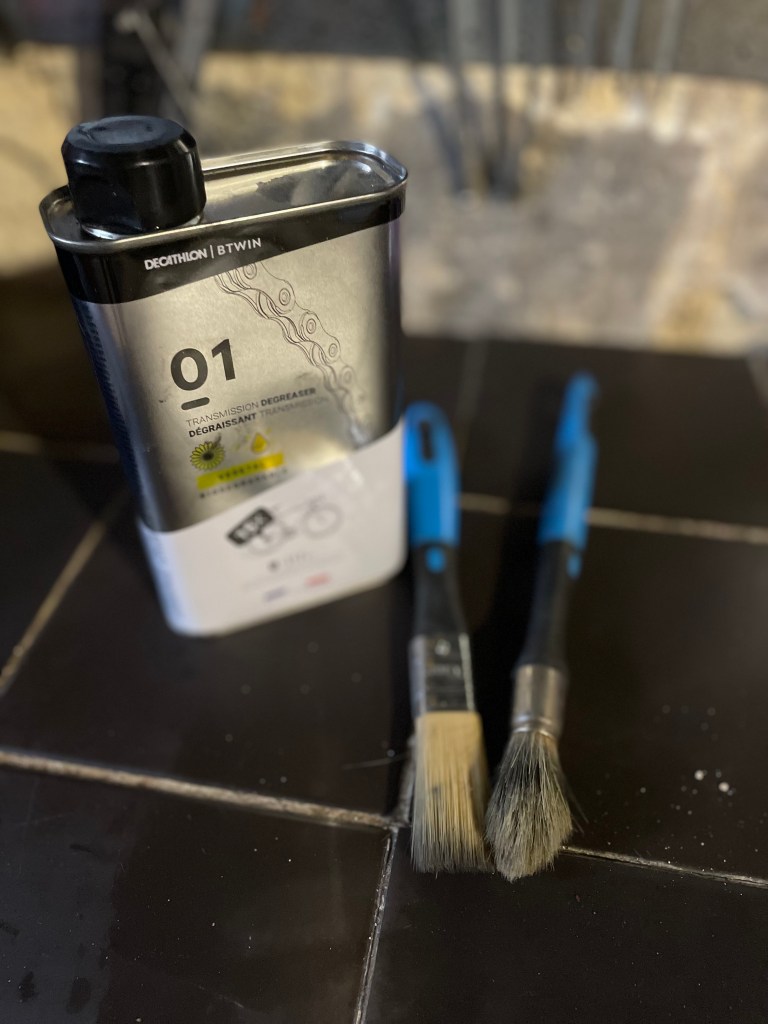
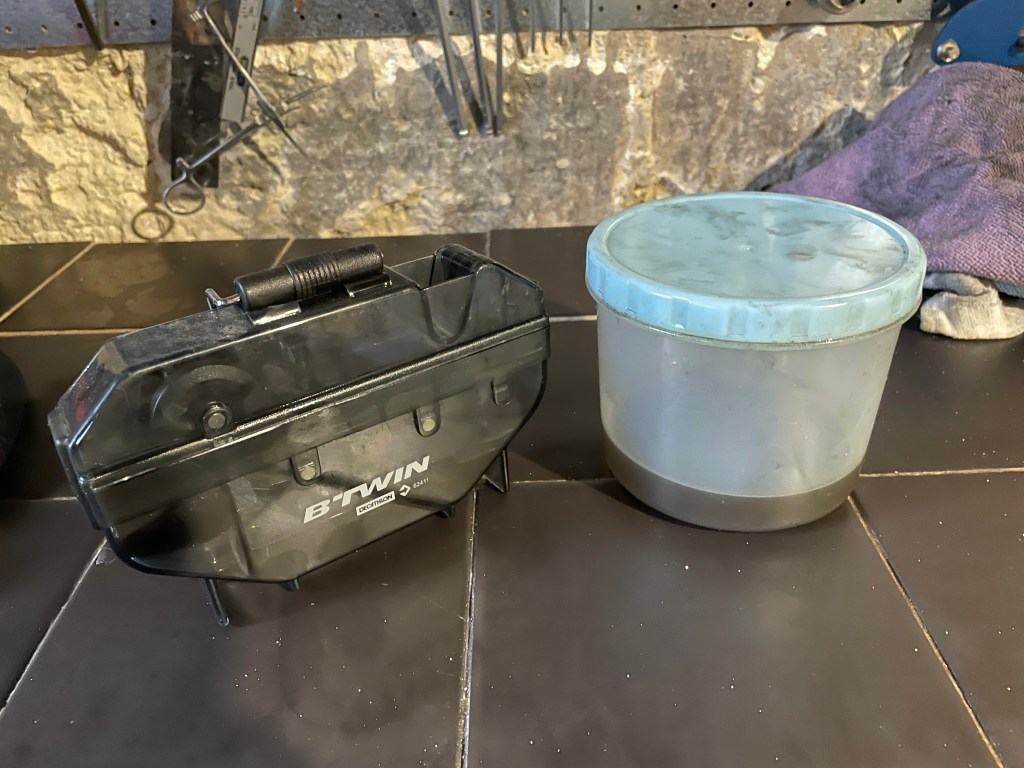
This Decathlon cleaner is fantastic for it. Use some simple cheaper paint brushes to apply. For brushes there is no need for high-end horse hair etc. I tend to find some great cheap ones in the supermarket. Apparently they are for cleaning stuff in the house (no idea where) but I just found a 2 euro one that is indispensable for cleaning around wheel hubs and between cassette chains rings. You can also go for a chain cleaner and yet again Decathlon do a great cheap one (see pic below)
You can spend a lot more on “cooler” brand ones but the Decathlon one does just as good a job and money spent can be used on more important things like the pub after a ride. A lot of Decathlon stuff is soooooo good, no need for snobbery. One of the best sets of gloves I have I got can from there, beating 60 euro goretex jobbies for a quarter of the price. The pot in the pic is for awful chains – in the worst case pull the chain off (much easier if you have a quick link but don’t reuse them too many times). An overnight soak sorts most sins.
You can also buy other dedicated chain cleaner sprays etc but I tend not to use them. I might resort of brake cleaner for cars as a last resort for real nasty stuff. But be wary with it as it will leave no film behind and corrosion can kick in. Also don’t use it near bearings as it will strip the grease in the guts and destroy them.
OK everything is shiny clean and it’s time to add lube. This is where there could be a thousand options but lets start with two. Wet or dry. They both go onto the chain wet but the dry one will dry up leaving a wax residue that acts as the friction reducer. It’s awesome in that as it is dry it means it will not collect all the crap you cycle through, but the wax will come off in rain and the lube effect is gone. Wet lubes stay wet and don’t get rained off – they also basically start what is a compost heap effect on your drive train building up layer after layer of ****. You know it’s an issue when you use a spoon to scrape all the crap off your jockey wheels. For me wet lube should only be used when you really need VERY low maintenance. I am thinking Boris bike or Velib, commuters bikes where the owner doesn’t maintain anything (anything with Schwalbe Marathon tires on them). For your pedigree race partner, they are worth a relube after every ride and hence mine only sees dry lube. And this is my biggest secret, as in the lube I use. Rock ‘n roll baby!!!
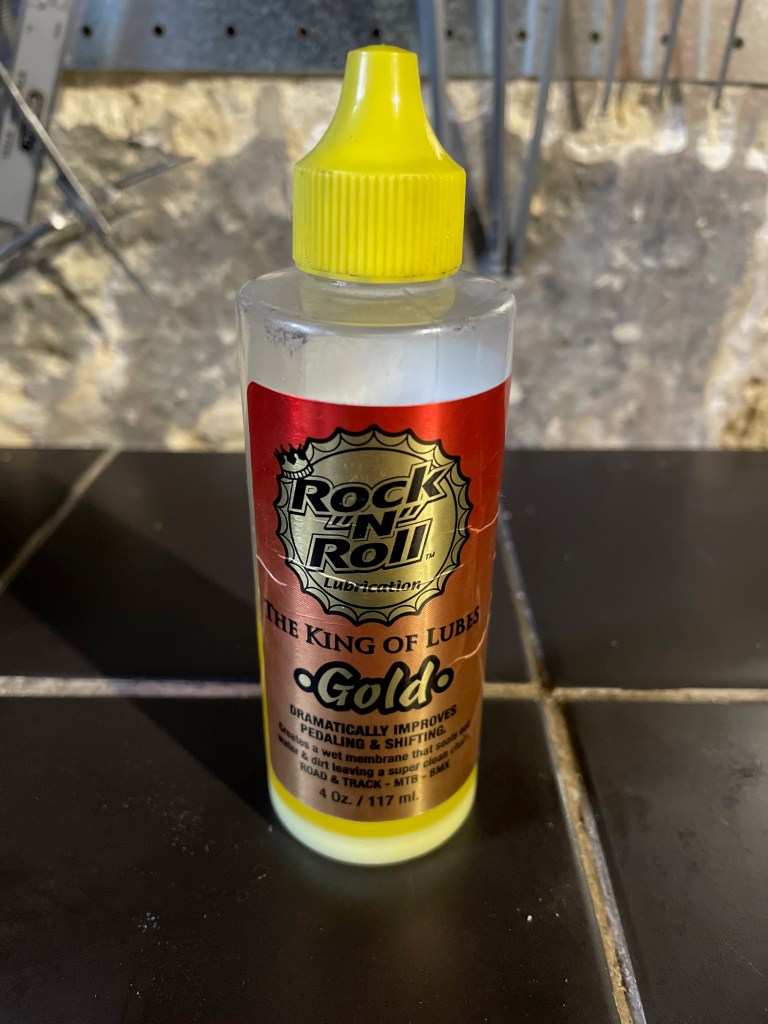
Rock “n” Roll Gold is the bees knees, the dog’s b*******, the gravy, the cream, the…. OK enough. In the picture above you will see a lighter band at the bottom of the bottle? That’s the wax. The fluid above is a carrier to apply and also a basic cleaner. After every ride I put the bike on the bike stand and apply to the chain at the rear cassette as I peddle a few times. I then leave this (minimum of 20 mins – but best overnight). Before a ride I’ll use a microfibre rag and clean off as much as I can. When done you might be forgiven for thinking there is nothing there but trust me, the was is in the links where it needs to be. It takes moments to do this – and the result? A clean, crisp, effortless shifting experience. It makes mechanical RIVAL/SORA feel like Di2. Ok a slight exaggeration but not that far off. You can buy the lube in big bottles and decant it into smaller ones that come in the same package for easier application. 5 mins spent for each ride MAX’ are so worth it.
So there you go – some basic stuff on how to make your shifting user experience as silky smooth as a very silky smooth thing indeed. Every time you now shift gear, the movement of that finger will be directly attached to the smile out loud nerve. Even on a single speed you’ll be annoying you ride soul mates who’ll be trying to figure out why you are always so frickin happy. That’s because a clean bike brings such joy and a well lubed chain make everything almost Nirvana. That’s it,I have to go. I’m too excited, I have to lube something. Rock n’ Roll baby!
 Sur Le Rivet